Introduction
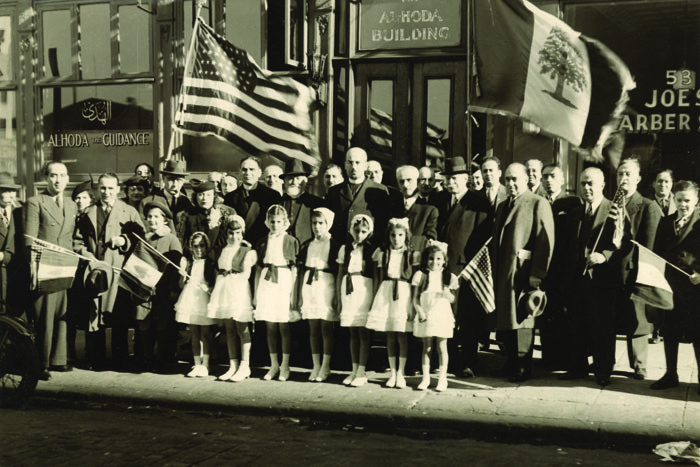
Image: Group of children in front of Al-Hoda newspaper building, Little Syria, NY, 1935.
During the early 20th century, the US federal courts heard a number of cases by immigrants from non-European nations who sought to naturalize by claiming whiteness. At the turn of the century, naturalization was restricted to “free white persons and to aliens of African nativity and to persons of African descent.” In 1896, George Dow, a Christian Syrian immigrant living in South Carolina, applied for naturalization. In 1914, the court heard his case in Ex Parte Dow, but rejected his petition, denying his claims to whiteness based on geographic origin. They argued that Syrians were “Asiatic” and thus not considered “free white persons.” Dow was granted a rehearing, but in the second case, In re Dow (1914), the court again denied his claim on the same grounds. In Dow v. United States (1915), after two unsuccessful attempts, Dow brought his case before the District Court to repeal the two lower court decisions. Ultimately, the court ruled in favor of Dow, affirming Syrians along with Armenians and Parsees as “white persons” and thus eligible for citizenship. The decision in this case set a firm legal precedent for Syrian whiteness, and for the next few decades, the question of Syrian racialization subsided. Despite naturalization no longer being racialized in the legal sense, cases like Dow’s were crucial in shaping contemporary American immigration history and showcase how deeply embedded the racialization of peoples was in creating modern American immigration policy.