Whats the Deal With Voting?
“The right of citizens of the United States to vote shall not be denied or abridged by the United States or by any State on account of race, color, or previous condition of servitude–” (US Const. amend. XV, sec. 1).
When the 15th Amendment was passed, it marked a monumental change in racial politics in the United States. For a time, the Amendment was largely successful in increasing black voter turnout and adding racial minorities to the registrar. The Reconstruction era after the Civil War saw a sharp increase in Black voting, as well as Black officials being elected to state and federal office for the first time. However, when reconstruction ended and federal troops were pulled out of the South, many states began to adopt work-arounds to the Fifteenth Amendment: more subtle laws and regulations aimed at disenfranchising Black voters (Library of Congress).
During the Jim Crow era, these laws and regulations took many forms, from poll taxes to grandfather clauses to literacy tests. Although many of these laws were taken to court under discrimination claims, the sheer volume of discriminatory practices being utilized rendered traditional litigation ineffective at resolving the broad issue of disenfranchisement. In her dissent in Shelby County, Justice Ginsburg notes that, “Early attempts to cope with this vile infection [voting discrimination] resembled battling the Hydra. Whenever one form of voting discrimination was identified and prohibited, others sprang up in its place,” (Shelby County v. Holder, 570 U.S. 529, 2 (2013) (Ginsburg, R., dissenting)).
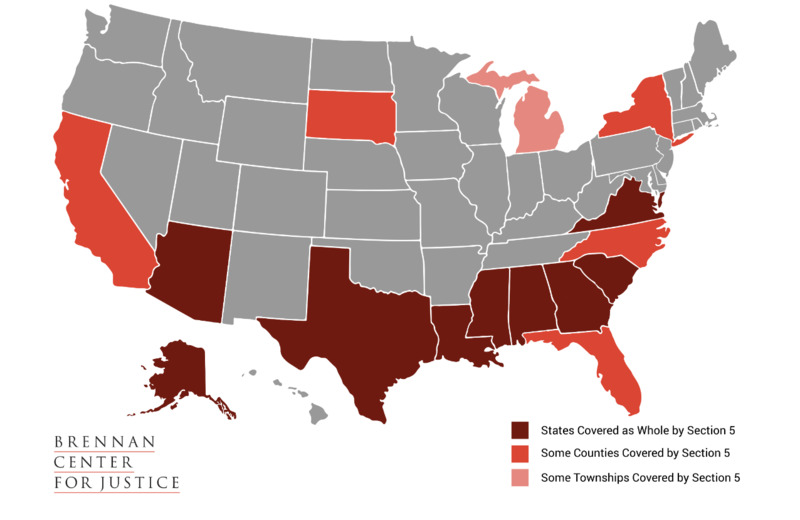
Map of jurisdictions covered by section 4(b) at the time of the Shelby County decision in 2013
The Voting Rights Act of 1965 was introduced as a response to the inadequate ability of the Fifteenth Amendment to protect against racial discrimination. Two sections of the VRA are at issue in Shelby County v. Holder: section 4(b) and section 5. Section 5 provides that states and jurisdictions with sufficiently recent and severe histories of racial discrimination must seek approval from the federal government before making changes to their voting regimes. This approval is called ‘preclearance’.
Section 4(b) determines the jurisdictions subject to the preclearance requirement of section 5. This is the coverage formula which states that a jurisdiction is subject to preclearance if:
- In 1964, it maintained any “test or device” as a prerequisite for voting
- In 1964, it had less than 50 percent of the eligible population registered to vote, or if less than 50 percent of the eligible population voted in the 1964 presidential election.
In 1965, the states of Alabama, Mississippi, Louisiana, Georgia, South Carolina, and Virginia were subject to preclearance under §4(b), as well as a number of other municipalities across the States. Although the preclearance provision was originally set to expire five years after its enactment, Congress reauthorized the VRA for five years in 1970, and then again for seven years in 1975, and for 25 years in 1982 (570 U.S. 529, 6 (Ginsburg, R., dissenting)). It was renewed for the last time in July 2006, approaching its expiration date in 2007.
Shelby County, Alabama was one of many jurisdictions covered by section 4(b) when it sued in DC District Court, seeking a declaratory judgement that sections 4(b) and 5 of the VRA were facially unconstitutional and calling for a permanent injunction against their enforcement. Both the District Court and the D.C. Circuit Court of Appeals ruled against Shelby County, finding, “...the evidence before Congress in 2006 was sufficient to justify reauthorizing §5 and continuing §4(b)’s coverage formula,” (570 U.S. 529), and confirming that other forms of litigation were insufficient in protecting the rights of minority voters, thus necessitating the continued enforcement of §4(b). In 2012 the case was appealed to the Supreme Court, which granted certiorari on the limited question of, “Whether Congress’ decision in 2006 to reauthorize Section 5 of the Voting Rights Act under the pre-existing coverage formula of Section 4(b) of the Voting Rights Act exceeded its authority under the Fourteenth and Fifteenth Amendments and thus violated the Tenth Amendment and Article IV of the United States Constitution,” (568 U.S. (2012)).