And Now?
The aftermath of the Court's ruling in Shelby County v. Holder was manyfold. It was widely criticized by the Democratic party for the impact it would have on the enforcement of the 15th Amendment, raising specific concerns about vote suppression and backsliding into prior discriminatory practices. Former President Barack Obama released a statement expressing disappointment in the Court's ruling, writing that, “today’s decision…upsets decades of well-established practices that help make sure voting is fair, especially in places where voting discrimination has been historically prevalent,” (Calmes, et al.). Unfortunately, many of the concerns raised after the ruling came down proved to be justified in the years following.
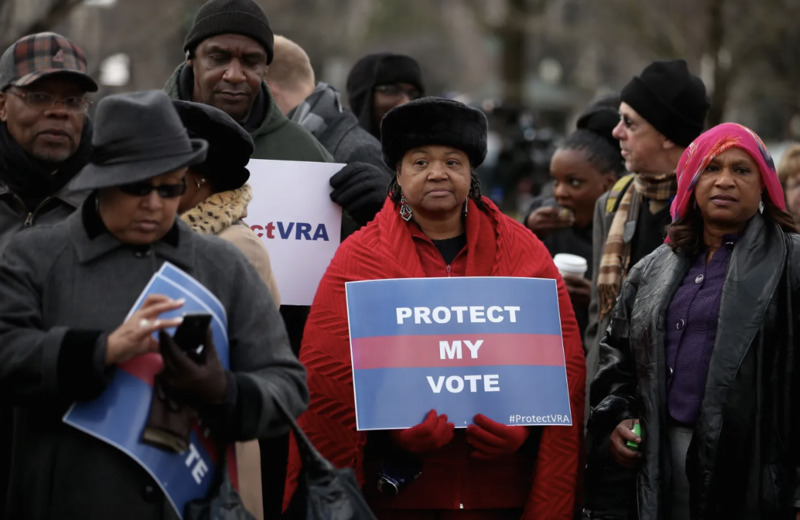
Protestors gather outside the U.S. Supreme Court during oral argument for Shelby County v. Holder in 2013
In 2024, the Brennan Center for Justice put together a report on the consequences of Shelby County, investigating increasing racial disparities in voting between 2008 to 2022. Although it is difficult to tie changes in voter turnout directly to the ruling in Shelby, the Brennan Center notes that the gap between white and minority voter turnout, “...grew almost twice as quickly in formerly covered jurisdictions as in other parts of the country with similar demographic and socioeconomic profiles,” (Morris and Grange, 3) in the years following the ruling.
In 2023, the Assistant Attorney General Kristian Clarke published a reflection on Shelby County, where she noted that the effects of the ruling in Shelby were immediate and noticeable. The same day the decision came down, Texas announced a new restrictive voter identification statute. One day later, North Carolina publicly announced the introduction of an omnibus law including multiple restrictive voting measures. Although successful lawsuits were eventually leveraged against both provisions, those lawsuits, “took years to litigate and consumed substantial resources, including millions of dollars spent by Texas and North Carolina to defend the state laws,” (Clarke).
Since 2013 a number of remedies have been proposed to fill the gap left in voting rights legislation by the ruling in Shelby County. The most prominent of these is the John R. Lewis Voting Rights Advancement Act, which would provide an updated formula for preclearance coverage, filing the place of section 4(b) and allowing section 5 to take effect once again (117th Congress). The bill has been proposed in the 116th, 117th, 118th, and 119th Congress, but has failed to pass each time. It has received significant criticism from conservatives, including former republican Senate leader Mitch McConnell (Dale).
The dilution of the Voting Rights Act through the Courts is a long and ongoing story: one that did not begin nor end with Shelby County. The ruling in Shelby was possible because of the good faith liberals have repeatedly extended to the conservative justices. Regardless of the degree to which one might agree with Roberts’ conclusion, he incorrectly applies precedent on the issue of state sovereignty, he ignores the historical relationship between the courts and the legislature, and he makes no attempt to go through the steps of applying a ‘congruence and proportionality’ test (a standard used to determine whether a piece of legislation remedying a constitutional violation is a legitimate response to the injury done) despite concluding that the VRA would not pass such a test. Ginsburg's dissent does a good job of dissecting the legal issues with the majority opinion, but it does not go far enough. Ginsburg argues that the ruling in Shelby allows for racism to re-emerge in the South; what she does not say is that this opinion, this case itself, is racist. It is racist to value a misconstrued interpretation of state sovereignty over the 15th Amendment rights of minorities. It is racist to believe that the United States is a colorblind nation, or to argue that the discriminatory experiences of racial minorities are not ‘bad enough’ to constitute a violation of their rights. The refusal to explicitly state when conservatives on the Court are acting in bad faith does nothing but legitimize their reasoning. It allows the blatant racism and weak constitutional interpretation done by the majority here to become precedent which can be cited in future cases to further the dismantling of provisions like the VRA. Already, we see related precedent showing up in more recent voting rights cases like Rucho v. Common Cause, 588 U.S. (2019), Alexander v. South Carolina State Conference of the NAACP, 602 U.S. (2024), and likely Louisiana v. Callais in the current Supreme Court term. Without a significant, concerted effort from the liberals on the Court and in the legislature to push an alternate interpretation of the VRA and Reconstruction Amendments– one that supports broad protections for civil rights– existing law will continue to be dominated by conservative ideology and rulings like Shelby County will pile up until the rights guaranteed by the Constitution are rendered inoperative.