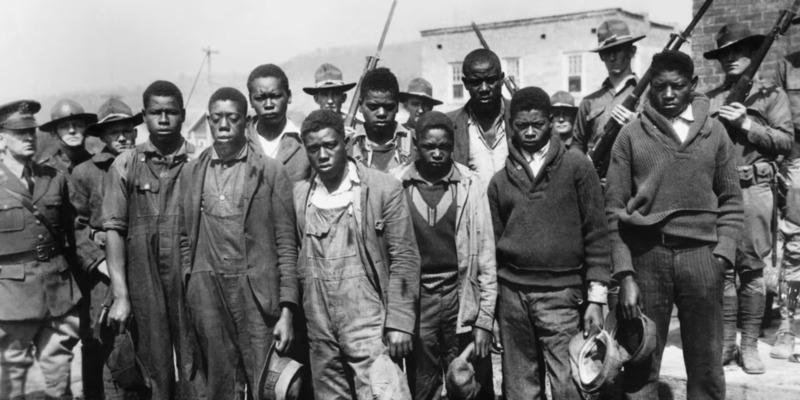
Fig 1. Bettmann Archive/Getty Images. Available from: HISTORY, https://www.history.com/articles/scottsboro-boys (accessed December 17, 2025). The Scottsboro Boys, surrounded by militia.
Powell v. Alabama ultimately established a precedent that those accused of capital crimes, if they are “unable to employ” a lawyer, would have one appointed by the court.[1] However, what makes Powell v. Alabama particularly noteworthy is the context to the case itself.
In 1932, deep in the throes of Jim Crow, two white women accused nine black youth (“young, ignorant, and illiterate”[2]) that while on a freight train in Alabama, they raped them.[3] Upon reaching its destination in Scottsboro (the defendants are often referred to as the Scottsboro Boys), the youth were arrested, surrounded by a large crowd of hostile onlookers.[4] Because of the fear of possible mob violence, the youth were always escorted by the military.[5] They pleaded not guilty, and they were quickly tried, convicted, and all but one sentenced to death.[6] They appealed their conviction to the Alabama Supreme Court, where it was affirmed (one death sentence was overturned because the defendant was too young), albeit with a scathing dissent from Chief Justice Anderson.[7] Upon further appeal to the United States Supreme Court, in a 7-2 decision, the court ruled that they were deprived of adequate counsel, a violation of the due process clause of the Fourteenth Amendment, and they vacated their convictions and ordered new trials.[8] Locally, this decision was deeply unpopular, as it evoked memories of federal intervention during Reconstruction that many white Southerners resented.[9] Yet, it also signaled a changing national opinion at large that would pave the way for other civil rights cases, perhaps those more embedded in the popular consciousness.[10]
[1] Powell v. Alabama, 287 U.S. 45 (United States Supreme Court 1932).
[2] Ibid.
[3] Michael J. Klarman, “The Racial Origins of Modern Criminal Procedure,” Michigan Law Review 99, no. 1 (October 2000): 48, https://doi.org/10.2307/1290325.
[4] Powell v. Alabama, 287 U.S. 45 (United States Supreme Court 1932).
[5] Ibid.
[6] Michael J. Klarman, “The Racial Origins of Modern Criminal Procedure,” Michigan Law Review 99, no. 1 (October 2000): 48, https://doi.org/10.2307/1290325; Powell v. Alabama, 287 U.S. 45 (United States Supreme Court 1932).
[7] Ibid.
[8] “Powell v. Alabama,” Oyez, accessed December 16, 2025, https://www.oyez.org/cases/1900-1940/287us45.
[9] Michael J. Klarman, “The Racial Origins of Modern Criminal Procedure,” Michigan Law Review 99, no. 1 (October 2000): 48, https://doi.org/10.2307/1290325.
[10] Ibid.