The Case
To sever, or not to sever
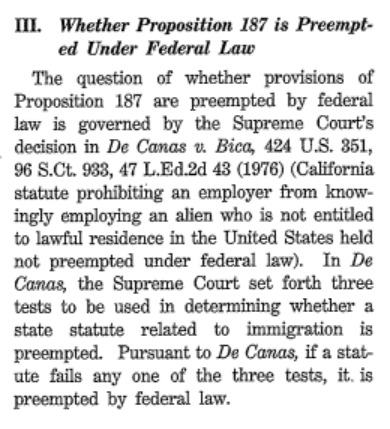
Even before civil suits on its first day in effect, crafters of the proposition were trepidacious of constitutional attacks. In anticipation of opposition, the language in the proposition in the 10th section amended no legal codes, but upheld that “In the event that any portion of this act or the application thereof to any person or circumstance is held invalid, that invalidity shall not affect any other provision or application of the act, which can be given effect without the invalid provision or application, and to that end the provisions of this act are severable”(2). This concept of severability (shown on the left) was indeed thoroughly utilized throughout the decision, as the defenders of the constitutionality of Prop 187 (Wilson and other Save Our State supporters), offered severability as an “alternative” to the entirety of Proposition 187 being determined to be unconstitutional. They argued that, even if Proposition 187 was found to be partially unconstitutional, the rest of the legislation should still be in effect. Prop 187 was found to have a “direct and substantial impact on immigration”(2) and therefore as a whole would be preempting the federal government’s authority to regulate immigration. LULAC vs. Wilson separated Proposition 187 into 10 sections and evaluated each section on its own validity. The Court relied on a three pronged test first introduced in De Canas vs. Bica. The left panel demonstrates the legal test each section was subject to.
LULAC vs. Wilson Summary:
The following summarizes each section and how it fared constitutionally on the De Canas test in Lulac vs. Wilson (3).
-
A notification system is established between state/ local agencies and federal authorities to prevent the use of public services by illegal aliens.
-
Completely preempted by federal law, since it exclusively serves to regulate immigration.
-
-
Additional language is added to the Penal Code to prohibit the “manufacture, distribution or sale” of false citizenship documents.
-
Criminal penalties do not serve to the express goal of determining who enters the state and do not pre-empt the federal government.
-
-
Additional language is added to the Penal Code to prohibit the use of false citizenship documents.
-
Criminal penalties do not serve to the express goal of determining who enters the state and do not pre-empt the federal government.
-
-
Additional language added to the Penal Code requires the verification of citizenship status of any arrested by state law enforcement and coordination with INS officials.
-
Found to be entirely preempted. Asking state authorities to determine immigration status and cooperate with federal authorities to ensure a person leaves the country is a direct attempt to regulate immigration.
-
-
Additional language added to the Welfare and Institutions Code that prohibits the use of public social services by illegal aliens.
-
Further severs this section to only allow services to be denied to undocumented illegal aliens without the classification and cooperation with legal authorities.
-
-
Additional language is added to the Health and Safety Code to prohibit the use of publicly funded healthcare by illegal aliens.
-
Severs this section to only allow services to be denied to undocumented illegal aliens without the classification and cooperation with legal authorities.
-
-
Additional language is added to the Education Code to verify the legal status of children and their parents/guardians enrolled in public schools.
-
De Canas not necessary, since Plyer vs. Doe found the Equal Protection Clause of the Fourteenth Amendment prohibits states from excluding undocumented children.
-
-
Additional language added to the Education Code that prohibits the use of post-secondary education by illegal aliens.
-
Further severs this section to only allow post-secondary services to be denied to undocumented illegal aliens without the classification and cooperation with legal authorities.
-
-
Additional language added to the Government Code that requires all local and state agencies to report anyone suspected of being in the United States illegally (this would include teachers, social workers, police, etc.)
-
Completely preempted by federal law, since it exclusively serves to regulate immigration.
-
-
Section 10 concerns severability in the event sections are found invalid.
The Failures of the De Canas Test
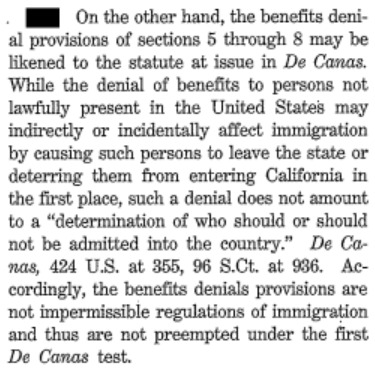
Featured left is the court justification for benefit-denial, stating that the court considered if each preempted immigration or if a statute “indirectly or incidentally” affected immigration by deterrence (making it less likely an undocumented immigrant would move to California). Essentially policy, that makes a group feel unwelcome is not necessarily illegal.
In Amanda Frost’s historical review of the United States vs. Wong Kim Ark, we see how discriminatory laws discouraged Chinese access to public services (2). In addition to the law, white mobs in California would destroy Chinese property and murder Chinese immigrants. One can argue that discriminatory laws both indicate the racist majoritarian sentiments at the time and perpetuate them. LULAC vs. Wilson is a case where a racialized issue is handled completely blind of the racialized impact. Proposition 187 and its proponents not being directly addressed for racialized roots indicates a lack of willingness to acknowledge where the law cements and classifies groups. In early Chinatown, race was a codified distinction. Immigration policy does something similar, where foreign born are classified differently, which contributes to the continuation and formation of prejudice of the foreign born and their natural-born descendants. Especially considering the rhetoric targeting Mexican-Nationals in the 1994 election season, it is not difficult to assert that a better decision would have considered the prejudicial impact. Without a conscious and deliberate effort to evaluate how ethnic and racial groups could be unfairly targeted due to the passing of Proposition 187 and its continued implementation, an opinion based solely in precedent and deferring to arguments in federalism miss the mark and members of racialized groups get targeted.
- Illegal Aliens. Ineligibility for Public Services. Verification and Reporting. California Proposition 187 (1994). https://repository.uclawsf.edu/ca_ballot_props/1104
- Frost, Amanda, "By Accident of Birth": The Battle for Birthright Citizenship after United States v. Wong Kim Ark (September 7, 2021). Yale Journal of Law and the Humanities, Vol. 32, No. 1, 2021, Available at SSRN: https://ssrn.com/abstract=3926759
- Expa. 1998. “Federal Judge Issues Final Ruling on Prop. 187 Measure Unconstitutional - ACLU of Socal.” ACLU of Socal. March 18, 1998. https://www.aclusocal.org/news/federal-judge-issues-final-ruling-prop-187-measure-unconstitutional/.